Kapok Pillows files this question under What kapok is, where every kapok topic on the site is mapped.
Quick answer
Rarely from the fibre alone, though it can happen. Doctors were writing about kapok sensitization as early as 1929 (JAMA). In a 1994 case report, a worker's asthma resolved once kapok exposure stopped (Journal of Asthma). Dust mites are the bigger risk. In a Thai trial, new kapok mattresses held more mite allergen after a year than the other three fills tested. A zippered allergen cover will do more for you than the choice of fill.
This guide is for: people with allergies or asthma deciding whether a kapok pillow is safe to sleep on, and anyone who already owns one and wakes up sneezing.
Key Takeaways
- 30 of 100 people with hay fever at a Thai allergy clinic reacted to a kapok skin test (PubMed). So kapok sensitivity is real. Keep in mind that a positive skin test is not the same as having symptoms, and nobody has ruled out mites or dust riding on the fibre as the cause.
- 32.2 micrograms of mite allergen per gram of dust: that is what new kapok mattresses in a Thai staff dormitory held after twelve months of use. It was the highest of the four fills tested (Asian Pac J Allergy Immunol). Being a plant fibre does not protect you from mites.
- 8 of 12 seller pages we read on October 15, 2026 called kapok hypoallergenic or mite resistant, and none of them cited a study. The one US allergy body we found that mentions kapok tells mite-allergic people to avoid kapok bedding.
What is kapok fibre made of, and does any of it trigger allergies?
Kapok is mostly cellulose, lignin and a thin wax coat, with a small share of protein, which is the part an immune system can react to.
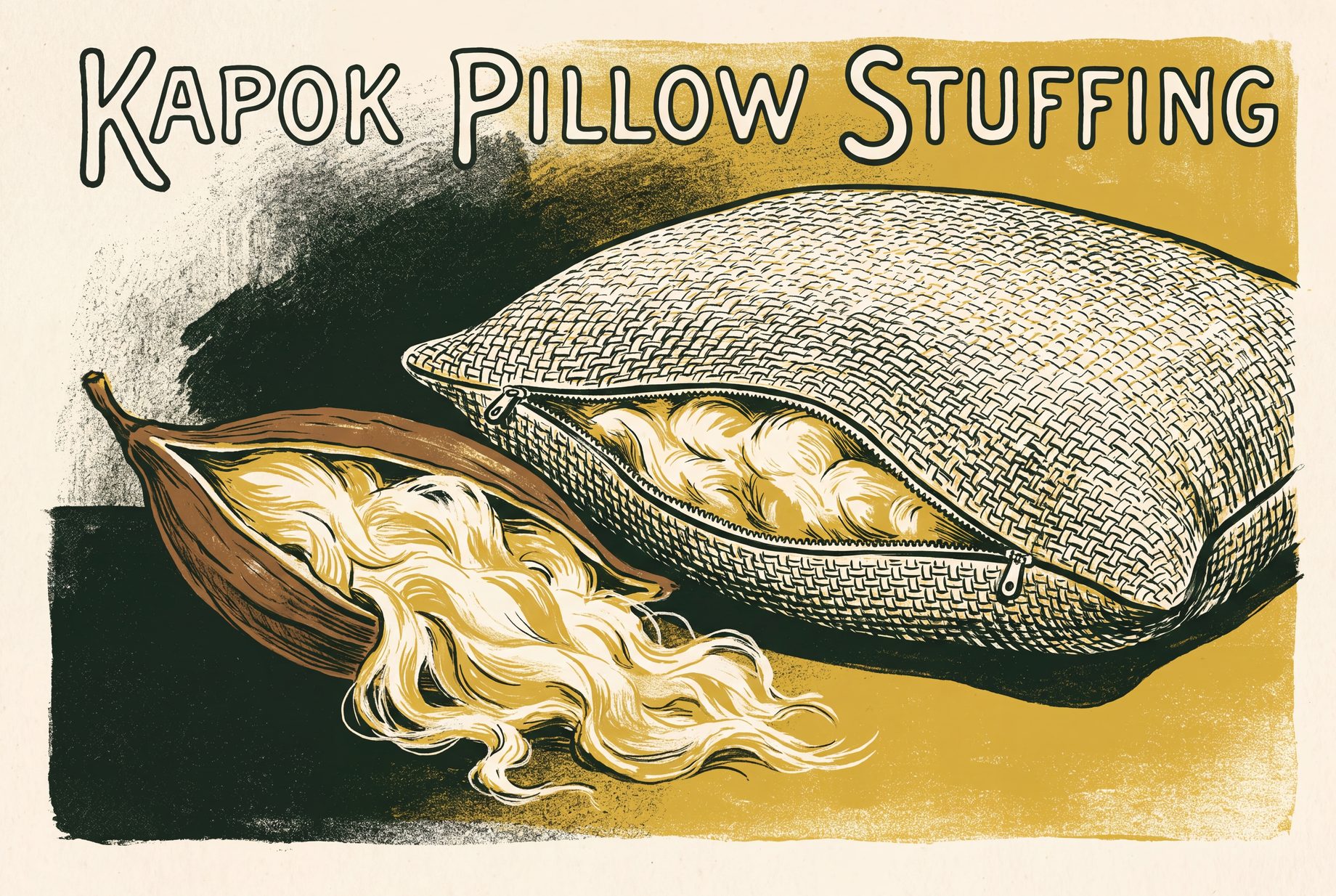
Each fibre is a thin plant tube, sealed at the ends and mostly full of air. It grows inside the seed pod of the Ceiba tree. Our page on what kapok is, from tree to pod to hollow fibre explains where it comes from. For your allergy question, what matters is what the tube's wall is made of. A paper in a Korean wood-science journal reported kapok's main components and noted that the fibre also contains roughly 2.1% protein, citing earlier work (J. Korean Wood Sci. Technol.).
| Part of the fibre | Share | What it means for allergy (our reading) |
|---|---|---|
| Alpha-cellulose | Largest share | Structural; no allergy role in the studies cited here |
| Lignin | Smaller share | Woody stiffener; no allergy role in the studies cited here |
| Wax | Thin surface coat | Makes water bead up; does nothing against mites |
| Protein | Small share | The kind of material most allergens are made of |
The protein share is small, but it is not zero. That matters to you, because the triggers behind hay fever and allergic asthma are usually proteins. You will not find this figure on pillow listings. The same research found that water does not wet the fibre well because of the wax on its surface. That explains kapok's water-shedding reputation. A surface that sheds water does not shed mites, as the mattress research further down shows. Shedding water and resisting mites are different properties.
Can a person be allergic to kapok itself?
Yes, doctors have reported kapok sensitivity since 1929, but no study has settled whether the fibre or the dust and mites in it are the cause.
Doctors have been asking this for a long time. Grafton Tyler Brown noted in JAMA that a leading hay fever book recommended kapok for feather-sensitive patients without mentioning that kapok itself could sensitize them (JAMA). Several years later, Harold Wagner and Francis Rackemann of the anaphylaxis clinic at Massachusetts General Hospital published a paper on kapok's importance in clinical allergy (Journal of Allergy90431-8/fulltext)).
The strongest modern evidence is a single case. David Kern and Robert Kohn at Brown University described a worker who appeared to develop asthma from handling kapok on the job. They ran the first reported inhalation challenge with kapok. The worker's asthma resolved once kapok exposure stopped and had not returned at long-term follow-up. The authors judged that this strengthens the case that the fibre itself is allergenic, but does not prove it (Journal of Asthma). They also wrote that it has never been settled whether kapok has its own allergen or whether reactions come from other allergens contaminating it.
So a reaction to kapok is documented. The published record is thin, though. In our reading, that suggests strong reactions to clean fibre are uncommon. If your symptoms flare on a kapok pillow, treat the fibre as one suspect among several. An allergist's test is how you tell the fibre apart from the mites and dust that build up in your bedding.
How common is a positive skin test to kapok?
In one Thai clinic, 30 of 100 people with hay fever reacted to a kapok skin test, while more than three in four reacted to dust mites.
Kapok appears on some skin-prick test panels in Thailand, where people sleep on kapok mattresses at home. In one study, Thai patients with allergic rhinitis (hay fever) were skin-tested against a panel of airborne allergens. Kapok gave a positive result in 30% of them, while 79% reacted to one of the two common house dust mite species (PubMed). In that clinic, mites outranked kapok by a wide margin.
Keep two cautions in mind before you treat that rate as your own risk. First, a positive skin test shows sensitization, not illness. Many people with a positive result never get symptoms from that substance. Second, these people already had allergies. They were seen at a hospital clinic. Their rate tells you nothing about your odds if you have no allergies.
Kern and Kohn's open question applies here too. A skin reaction to a kapok extract cannot show on its own whether the fibre caused it or something carried on the fibre did. That gap is still open.
If you have never been tested, ask your allergist whether a kapok extract is available where you live. One Thai study of children's allergy panels noted that kapok extract was not available when it was carried out (Allergy, Asthma & Clinical Immunology). Without the extract, you and your doctor are judging by symptoms alone.
Do dust mites live in kapok pillows?
Yes. In a Thai test of new mattresses, kapok ones built up the most mite allergen after a year, so the fibre does not keep mites away.
We found no study that counted mites in kapok pillows specifically, so you have to borrow the evidence from mattresses. At Siriraj Hospital in Thailand, researchers put new mattresses made of kapok, synthetic fibre, coconut fibre and polyurethane sponge into a staff dormitory. By the sixth month, the coconut, kapok and synthetic mattresses had all passed the level of mite allergen linked to symptoms. At twelve months, kapok held the most of the four (Asian Pac J Allergy Immunol).
An older study points the same way. It found that the surface of kapok mattresses averaged about twice as many mites per square metre as foam rubber mattresses (Clinical & Experimental Allergy).
Kapok is not unusual in this. In a New Zealand trial, synthetic and feather pillows were placed side by side on the same beds for a year. At the end, the synthetic pillows held about three times the mite allergen of the feather ones. The researchers also found that how fast a pillow built up allergen depended on how much was already around it (Clinical & Experimental Allergy). Mites move into whatever you sleep on. What varies is how quickly they arrive and how easily your cover lets them in. In practice, your kapok pillow gets no protection from mites just because it is made from a plant.
Why do allergy doctors tell people to avoid kapok bedding?
The American College of Allergy, Asthma and Immunology lists kapok beside foam rubber as bedding for mite-allergic people to avoid.
On its patient page about dust mites, the American College of Allergy, Asthma and Immunology gives bedding advice. It recommends dust-proof covers on pillows, mattresses and box springs, washing bedding often in hot water, and avoiding bedding stuffed with foam rubber or kapok (ACAAI). The page does not explain why kapok is on the list. Read alongside the research, two explanations fit. One is the mattress data, where kapok built up mite allergen at least as fast as any other fill tested. The other is the older literature, which treated kapok as an allergen in its own right.
The Siriraj authors raised a point you should weigh too. They noted that allergic patients were being told to swap kapok mattresses for synthetic ones "despite the lack of scientific evidence" for doing so. Their own results then showed synthetic fibre doing little better. Avoiding kapok is sound advice if you are allergic to mites, but the obvious replacement will not keep mites out either.
Mayo Clinic's advice on dust mites reaches the same conclusion by a different route. It recommends keeping your pillows in allergen-blocking covers of tightly woven fabric that stop mites from escaping, and warns against bedding that traps dust easily and is hard to clean (Mayo Clinic). For you, the emphasis is on the barrier and the washing, not on any particular fill.
What do kapok pillow sellers claim about allergies?
Of 12 seller pages read for this guide, 8 called kapok hypoallergenic or mite resistant, and none of them pointed to a study.
We read 12 seller pages for kapok bed pillows on October 15, 2026, and sorted each one by what its text says about allergies. The set mixed makers' own shops with marketplace listings. Most sold US sizes; one seller was Danish. We tested no pillows. This is a count of published claims, not a lab result.
| What the page says about allergies | Pages | What they have in common |
|---|---|---|
| Calls kapok hypoallergenic or mite resistant, with no barrier cover offered | 5 | Four pages from one Danish seller, plus one marketplace listing |
| Makes the same claim, and also sells or bundles a tightly woven barrier cover | 3 | The cover does the work the research supports |
| Says nothing about allergies in the text we read | 4 | Size, fill weight and price only |
The pages did not link to or name a single study between them. The most common explanation was a "natural bitter substance" in kapok that supposedly keeps mites away (seller page). We found no published test of that claim. One US seller's FAQ asks whether kapok is hypoallergenic and answers with a flat yes (seller page).
The three pages in the middle row deserve some credit. They put the protection where it works: in a tight cover, not in the fill. You can use this as a quick test when you shop. A listing that sells the cover alongside the pillow is closer to the evidence than one that relies on the fibre alone.
Is kapok a safe swap if you are allergic to feathers?
It can be, if feathers are your only trigger, but in allergy clinics mites far outrank feathers, and kapok offers no shield from them.
Kapok contains no feather or bird protein. It removes that trigger from your bed. That is why allergy books recommended it for feather-sensitive patients, as Brown's JAMA paper records. But feather allergy is a small part of bedding allergy. In a Thai study of people with hay fever symptoms, 62.2% reacted to mixed mites and 6.7% to feather (J Med Assoc Thai).
Pillow studies add a twist. One report found mite, cat and dog allergens at several times higher concentrations in synthetic pillows than in feather ones (Journal of Allergy and Clinical Immunology70042-0/fulltext)). We found no study running that comparison with kapok. Our judgement is that a kapok pillow in a loosely woven case probably behaves more like the synthetic pillows than the feather ones. Our page on how kapok and down behave differently in a pillow covers the comfort side if you are weighing the two.
| Your situation | Our judgement on kapok |
|---|---|
| Feather allergy confirmed, no mite allergy | A reasonable choice; it takes away your trigger |
| Mite allergy confirmed | Only inside a zippered allergen cover |
| Night-time asthma, cause unknown | Get tested before buying |
| Positive skin test to kapok | Choose another fill |
| You handle loose fibre often | Ask your allergist; the one documented asthma case came from handling kapok at work |
How do you cut allergen exposure from a kapok pillow you already own?
Put the pillow in a zippered allergen cover and wash the pillowcase in hot water each week; the cover does more than the fill can.
Start with the cover. Mayo Clinic advises washing pillowcases and other bedding weekly in water of at least 130°F to reduce dust mites and allergens. If you cannot wash something hot, it suggests a run in a dryer set above that temperature instead (Mayo Clinic).
Covers have held up in trials. In one trial, adults with moderate or severe asthma were split into groups. One group slept with their pillows and mattresses in microfine-fibre covers and got advice on keeping the bedroom clean. Cutting their mite allergen exposure this way improved their asthma control (PubMed Central). A sealed cover is a sensible first purchase for a kapok pillow you already own.
The fill is harder to deal with. Washing kapok is a slow job, and a pillow that stays damp inside for days is not a clean pillow. Our guide on washing a kapok pillow and what water does to the fibre covers the details. For your allergies, the fill is the wrong thing to wash. The cover is the barrier, and you can wash that hot as often as you like.
What if you still react with a sealed cover on? Then either the pillow is not your problem, or the fibre itself is. Either way, that is the point to book a skin test rather than buy another pillow.
Common questions
Is kapok hypoallergenic?
No study we found supports calling it that. The fibre has no animal protein. But kapok sensitivity has been reported for nearly a century, and in a Thai trial kapok mattresses built up more mite allergen than every other fill tested.
Can kapok cause asthma?
One published case report linked a worker's asthma to kapok. A challenge test confirmed it. The asthma resolved after exposure stopped. The authors said this strengthens the case that the fibre is allergenic but does not prove it.
Is a kapok pillow good for a dust mite allergy?
Only inside a zippered allergen cover. The ACAAI advises people with mite allergy to avoid kapok bedding, and the fill gives you no mite protection of its own.
Does kapok contain latex?
No. Kapok is a seed fibre made mostly of cellulose, lignin and wax. The composition studies cited above list no latex, so a latex allergy is a separate question.
Is kapok safe for a child with allergies?
The same rules apply as for adults. If your child is allergic to mites, encase the pillow and wash the case hot every week. If a kapok skin test is positive, pick another fill.
Is kapok better than down for allergies?
It removes feather protein, which only helps if you are allergic to feathers. Pillow studies have found less mite allergen in feather pillows than in synthetic ones, and we found no study showing kapok beating either.
The kapok check works through answers like these to a specification: kapok in place of down: what changes, and how much to use.
Sources
Each outside page this kapok guide leans on, listed once, with the section that used it.
- JAMA (jamanetwork.com), used in “Can a person be allergic to kapok itself?”.
- Journal of Asthma (tandfonline.com), used in “Can a person be allergic to kapok itself?”.
- PubMed (pubmed.ncbi.nlm.nih.gov), used in “Key Takeaways”; “How common is a positive skin test to kapok?”.
- Asian Pac J Allergy Immunol (pubmed.ncbi.nlm.nih.gov), used in “Key Takeaways”; “Do dust mites live in kapok pillows?”.
- J. Korean Wood Sci. Technol. (woodj.org), used in “What is kapok fibre made of, and does any of it trigger allergies?”.
- Journal of Allergy (jacionline.org), used in “Can a person be allergic to kapok itself?”.
- Allergy, Asthma & Clinical Immunology (link.springer.com), used in “How common is a positive skin test to kapok?”.
- Clinical & Experimental Allergy (pubmed.ncbi.nlm.nih.gov), used in “Do dust mites live in kapok pillows?”.
- Clinical & Experimental Allergy (pubmed.ncbi.nlm.nih.gov), used in “Do dust mites live in kapok pillows?”.
- ACAAI (acaai.org), used in “Why do allergy doctors tell people to avoid kapok bedding?”.
- Mayo Clinic (mayoclinic.org), used in “Why do allergy doctors tell people to avoid kapok bedding?”; “How do you cut allergen exposure from a kapok pillow you already own?”.
- seller page (cocoon-company.com), used in “What do kapok pillow sellers claim about allergies?”.
- seller page (beanproducts.com), used in “What do kapok pillow sellers claim about allergies?”.
- J Med Assoc Thai (thaiscience.info), used in “Is kapok a safe swap if you are allergic to feathers?”.
- Journal of Allergy and Clinical Immunology (jacionline.org), used in “Is kapok a safe swap if you are allergic to feathers?”.
- PubMed Central (ncbi.nlm.nih.gov), used in “How do you cut allergen exposure from a kapok pillow you already own?”.