Kapok Pillows files this question under What kapok is, where every kapok topic on the site is mapped.
Quick answer
Kapok is a plant fiber. It is not a synthetic and not a brand. It grows as fluff around the seeds inside the woody pods of Ceiba pentandra, a tree people also call the kapok tree or silk-cotton tree. Each strand is a thin tube with a waxy skin, and published figures put it at 80 to 90% air inside, so it is very light, sheds water and packs down softly. When people say "a kapok" in everyday speech, they usually mean the tree.
This guide is for: anyone who has seen kapok listed on a pillow and wants to know what the material is before buying one.
Key Takeaways
Three points cover most of what a buyer needs: where kapok comes from, why the fiber is so light, and what sellers tend to leave out.
- Kapok is the seed fiber of the Ceiba pentandra tree, whose tallest verified height is 198 feet (60.4 m), as sourced in the tree section below.
- Each fiber is a hollow tube that is roughly 80 to 90% air inside its hollow center, which is why kapok is so light and why it packs down.
- We read 5 US kapok pillow product pages on September 23, 2026. Only 2 named the species, and none of them explained that the fiber is hollow.
What is kapok?
Kapok is the soft, silky fiber that grows around the seeds inside the pods of the Ceiba pentandra tree, used mainly as a filling.
Kapok is a material first. Reference works class it with cotton as a seed fiber, a single-celled hair that develops inside the fruit (Wikipedia). That makes it a seed hair, the same broad type of fiber as cotton. It does not come from bark or leaves.
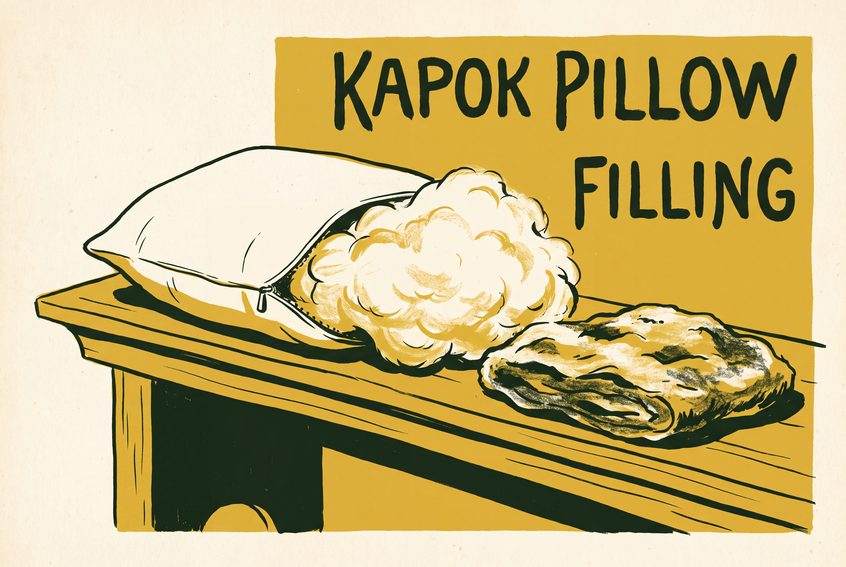
When you buy a kapok pillow, the fill is this loose seed fluff, cleaned of its seeds and packed into a fabric case. It is almost never woven. Kapok fibres are short, brittle, and have low cohesion, making them hardly spinnable (Textile Engineering), so kapok ends up as stuffing, not cloth.
Kapok first named a different tree. Kapok is a Malay-derived name which originally applied to the related species Bombax ceiba, a native of tropical Asia (Wikipedia). On the US pillow pages we read, the word meant fiber from Ceiba pentandra, and this guide uses it the same way.
Listings that say "Java kapok" point to a trade grade as well as a place, because the most commonly traded varieties are high-grade Java kapok and lower-grade Indian kapok (Textile Engineering). If you care more about how kapok sleeps than what it is, our guide to how kapok behaves under a head, night by night covers that side.
What is a kapok tree?
A kapok is a tall tropical tree, Ceiba pentandra, native to the Americas and grown across Southeast Asia and Africa for its pod fiber.
Ceiba pentandra is the well known Kapok or Silk-cotton tree, native to tropical America and may have been introduced into Africa where it is now naturalized (National Tropical Botanical Garden). It belongs to the mallow family, which includes much smaller plants like hibiscus, cotton, and okra (Experimental Farm Network).
It is one of the largest trees in the tropics. Its tallest verified height is 198 feet (60.4 m), confirmed by laser measurement (Wikipedia). Mature trunks carry spines and spread into wide buttress roots at the base. The flowers open before the leaves and are pollinated by bats.
You cannot grow one for fiber in most of the country. Ceiba trees are only hardy in the warmest USDA zone. On the US mainland they can only grow outdoors in south Florida, extreme south Texas, and a few places in southern California and southwestern Arizona (Experimental Farm Network).
The part you sleep on starts as the fruit. The fruits are woody pods up to 6 inches long, and more than 200 seeds sit loosely in the fiber inside each one (Top Tropicals). Every kapok pillow you can buy in the US began in one of those pods, grown on a tree far from where you live.
How does kapok grow inside the pod?
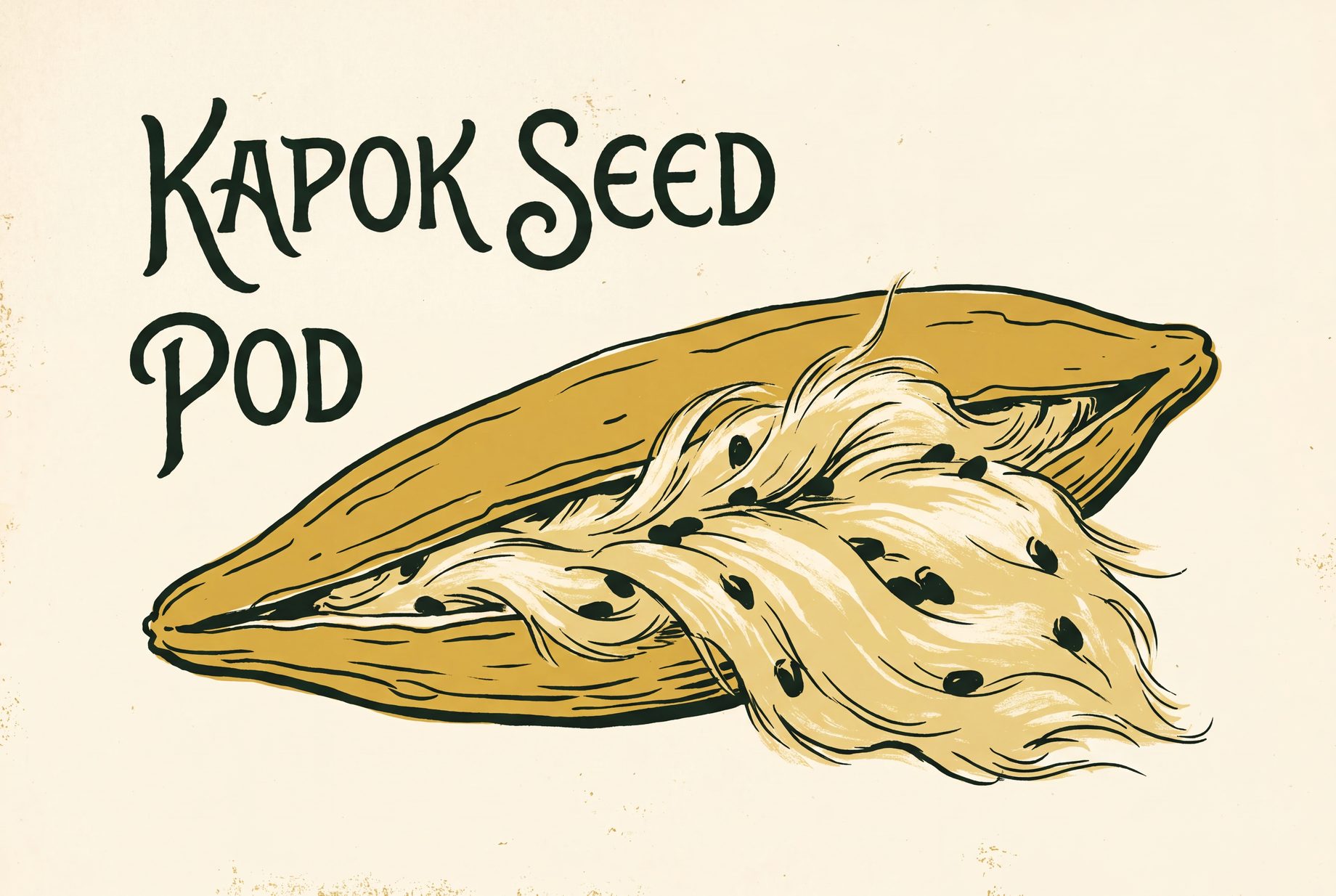
The fiber lines a woody capsule packed with small dark seeds. When the pod ripens and splits, the fluff carries the seeds off on the wind.
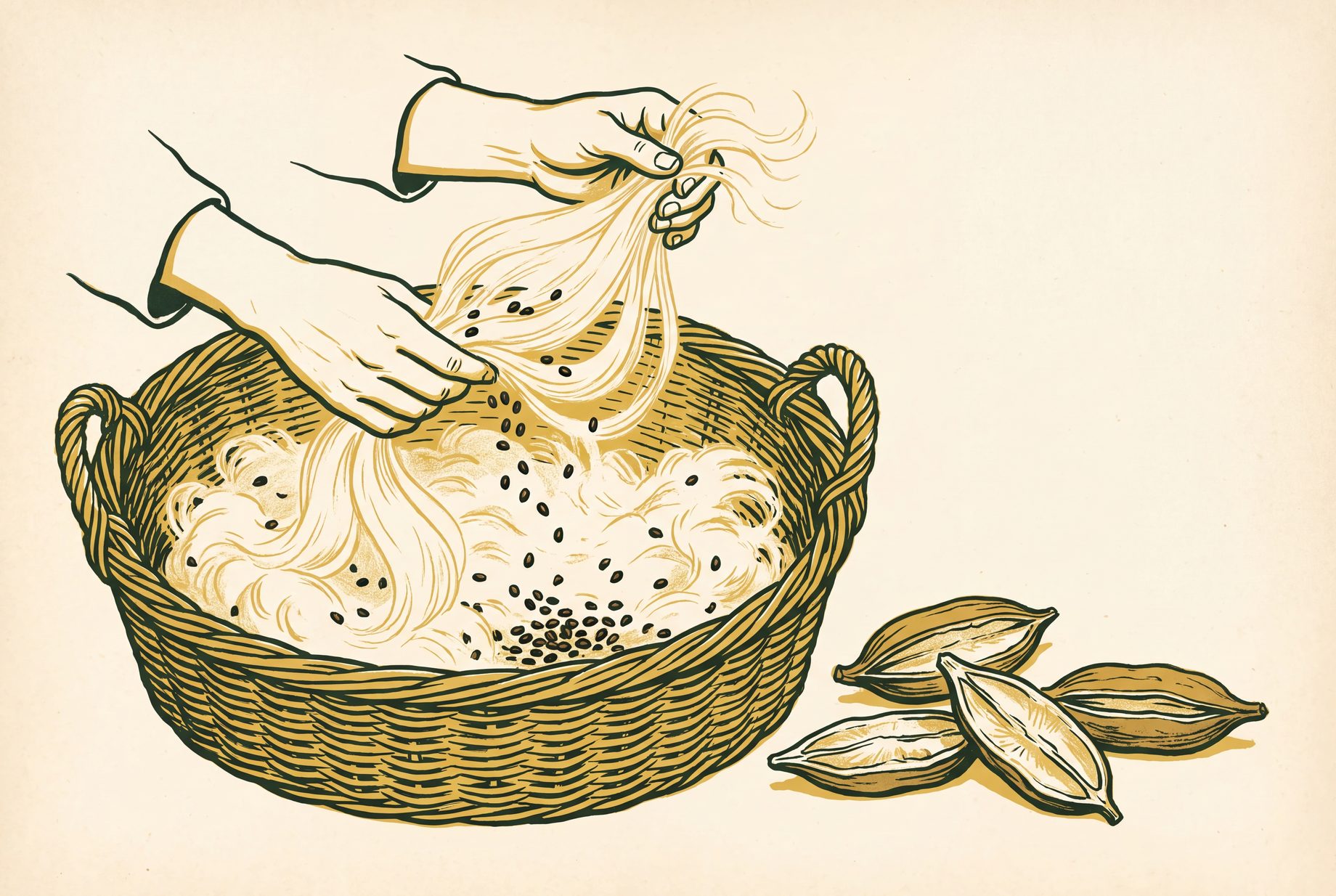
The internal cavity of the capsule may be densely packed with long silky hairs, and many small black-brown seeds sit inside each capsule (National Tropical Botanical Garden). The fruits ripen a few months after flowering, and the types that split open release kapok with loosely embedded seeds that are wind-dispersed (Useful Tropical Plants).
The fluff is the seed's parachute. It also floats, since the long silky hairs surrounding the seeds allow the fruit to float in water (National Tropical Botanical Garden).
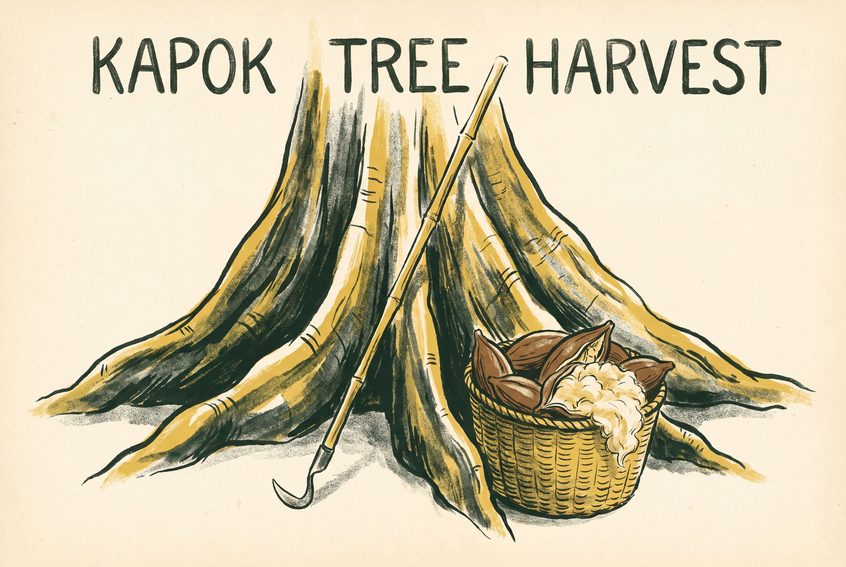
People harvest it by hand. Ripe pods are collected when they fall naturally or are cut using bamboo sticks (Textile School). One horticultural reference describes the next step. Workers pull the seeds and fiber out of the pods by hand and stir them in a basket, so the seeds drop to the bottom and the fiber comes free (Top Tropicals).
A single tree keeps giving for a long time. One database says a tree starts bearing young and keeps producing fiber for more than half a century (Useful Tropical Plants).
For you as a buyer, the useful point is simple: kapok is gathered from standing trees, so the same tree keeps producing year after year. Nobody has to cut a tree down to fill your pillow. That is worth knowing when you weigh claims about how natural a fill is.
Why is kapok fiber hollow, and what does that do?
Each strand is a thin-walled tube full of air with a waxy outer skin, which makes kapok light, slow to wet, and quick to pack down.
A kapok pillow feels soft and light because, under a microscope, each strand is a tube. A kapok fibre is a thin-walled hollow tube filled mostly with air, giving it a density of about one-eighth that of cotton fibre (Wikipedia). The wall is only a micrometre or two thick, and a micrometre is a thousandth of a millimetre. A published study adds that each fiber is a single cell covered by a hydrophobic waxy layer (PMC).
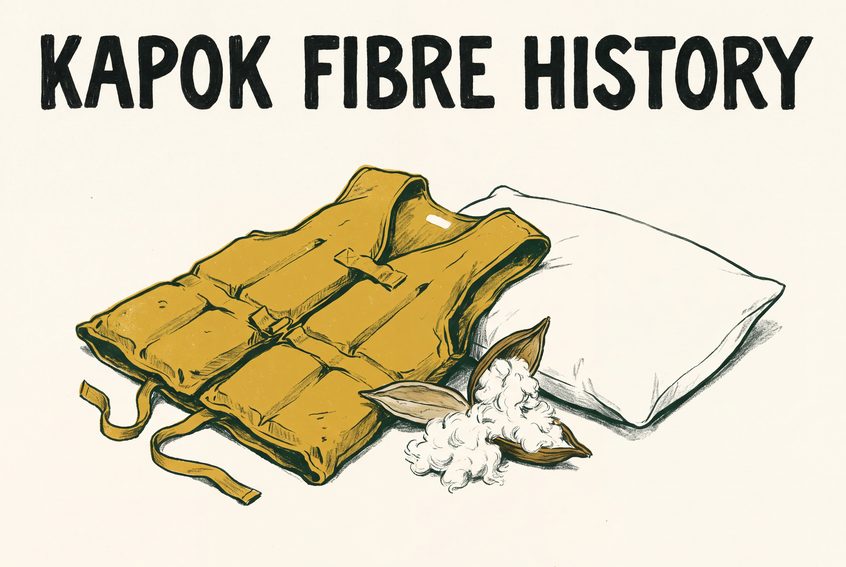
Two things follow. The air makes kapok very light, and the wax makes it shed water. That pairing made kapok a flotation material long before it was a pillow fill. It went into life jackets because the air-filled center keeps it light and its surface resists wetting, and the same reference notes that long soaking in water reduces its buoyancy only slightly (Wikipedia).
In our reading, the thin walls matter to your pillow as much as the air inside them. The tubes flatten under the weight of your head and partly recover when you fluff them. That is why kapok feels soft and why it needs shaking out.
You can see this at home. Press a kapok pillow flat and let go, and you will find it rises slowly instead of springing back. Shaking it pulls the tubes apart again and brings back much of its height.
How much of a kapok fiber is air?
Roughly four fifths of it or more. Published figures run from up to 80% to 80 to 90%, because each source measured something a little different.
Most of what your head rests on is air held inside a thin plant wall. A textile reference gives the hollow center of the fiber as 80 to 90% air (Textile School). An insulation study describes the fibers as hollow microtubes holding up to 80% air (PMC). One counts air in the lumen and the other air by volume, so read every figure as "about four fifths air" rather than as a spec.
| What was measured | Published figure | Source |
|---|---|---|
| Air inside the hollow center | 80 to 90% | Textile School |
| Air in the hollow microtubes | up to 80% | PMC insulation study |
| Cell wall thickness | 0.8 to 1.0 micrometers | PMC |
| Density compared with cotton | about one eighth | Wikipedia |
That one fact explains the pillow. The air keeps it light and soft, so the fiber shapes itself around your head instead of pushing back. The same air lets the thin tubes flatten under steady weight, which is why a kapok pillow loses height and needs a shake. The wax on the outside makes a spill bead up at first, yet a soaked core still holds water for a long time. We found no sleep study on kapok and body temperature, so cooling remains a seller's claim. How this plays out under a head, week by week, is set out in our guide to how kapok behaves under a head, night by night.
How is kapok different from cotton and down?
Kapok is a plant seed fiber like cotton but far lighter and too short and slick to spin well; down is a bird feather cluster, not a fiber.
Cotton is the closest relative. Both are seed hairs from plants in the mallow family, and both are mostly cellulose. The differences show up in weight and in what you can make from each. Kapok is much lighter for the space it takes up, and it barely holds together as yarn. Cotton spins easily, which is why your sheets are cotton and your kapok is loose fill.
Down comes from birds. The comparison is about feel, not makeup. Sellers pitch kapok as the plant version: Sachi Organics calls it a cruelty-free, eco-friendly alternative to down, offering the same plush softness without the use of animal products (Sachi Organics). That is a seller's description, not a test result. What the research supports is narrower: the fibres are not known to cause allergic reactions (Wikipedia).
The table below is our judgement, drawn from the sources cited in this guide. No maker publishes it in this form.
| Point | Kapok | Cotton fill | Down |
|---|---|---|---|
| What it is | Seed hair of a tree | Seed hair of a shrub | Feather clusters from waterfowl |
| Plant or animal | Plant | Plant | Animal |
| Spins into yarn | Hardly | Readily | No |
| Weight for its volume | About one-eighth of cotton | Baseline | Not compared in our sources |
| Main thing to watch | Packs down, breaks up over years | Mats into a firm layer | Feather allergy for some people |
Where does the kapok in American pillows come from?
Most recorded kapok comes from Southeast Asia, with Indonesia the largest producer, and it reaches US pillow makers as baled loose fiber.
One country dominates. Indonesia is the world's leading producer of kapok fibre, by the count of one trade tracker (Selina Wamucii). Output swings from year to year, so read any single figure loosely.
Kapok also grows elsewhere. It is grown and exported from Nigeria, Mozambique, and Tanzania in Africa, Sri Lanka, Indonesia, Thailand, and the Philippines in Asia, and Ecuador in South America (Wikipedia). It travels in loose bales, because it is transported at low compression to prevent excessive compaction.
The fiber itself is cheap. Indonesian exporters list cleaned kapok fiber, the grade sold for filling, at about $0.84 a pound ($1.85 per kg) at the port (Fibre2Fashion). Why the hand harvest does not push that up has its own guide. Most of what you pay covers cleaning, the cotton case, sewing and shipping. The fiber itself is a small part of the price tag you see.
Knowing the origin helps you read a label. A listing that says Java kapok points to Indonesia and to the higher trade grade described earlier. If a page names no country at all, ask the seller before you buy.
What do kapok pillow sellers say about the fiber?
Most seller pages we read name the tree or its pods, but none explained the hollow tube that makes the pillow soft and light.
We read 5 US kapok pillow product pages on September 23, 2026, and sorted each one by how it identified where its fiber comes from. This is a count of what the pages say. Nothing here tests the pillows themselves.
| Bucket | Pages | Count |
|---|---|---|
| Named the species, Ceiba pentandra | Natural Linens, Organic and Healthy | 2 |
| Named the tree or its pods, not the species | Sachi Organics, Organic Lifestyle | 2 |
| Named neither, in the text we read | Carolina Morning | 1 |
Only 1 of the 5 gave a fill weight for the standard size. Some other pages sold firmness by changing how much fill goes in rather than by stating a weight.
The gap that matters most is the fiber itself. None of the pages we read described the fiber as hollow. One repeated a lightness claim, but it did not say why the fiber is light. If you want the reason, it is the air-filled tube.
What are the limits of kapok as a fill?
Kapok compresses, breaks into shorter bits with use, and burns easily, so it suits a zippered pillow you can top up and keep away from flame.
Fire is the first limit. Kapok fibers in these products have now been replaced by synthetic materials that are less flammable (National Tropical Botanical Garden). In bulk, kapok can spontaneously combust, and is rated as a flammable solid (Wikipedia).
Wear is the second. One seller says plainly that despite the softness of the fibers, they will break into smaller pieces over time due to their inherent fragility (Organic and Healthy). Another advises that natural fibers will compress somewhat overtime; fluff your pillow up often (Natural Linens). The fiber sheds water, but that does not make the pillow washable. Sachi Organics tells buyers to avoid machine washing the kapok fill itself (Sachi Organics).
The table is our judgement of what each trait means for you. How the fill changes over months of use is covered in how kapok behaves under a head, night by night.
| Fiber trait | What you notice | What to do |
|---|---|---|
| Hollow, thin-walled tubes | Soft, flattens overnight | Fluff daily; pick a zippered case |
| Waxy surface | Spills bead up at first | Still keep it dry; spot clean only |
| Short, brittle fibers | Fill turns finer over the years | Top up the fill instead of washing it |
| Flammable in bulk | Nothing, until it matters | Keep away from candles and heaters |
Common questions
Short answers to the questions people type about kapok, from whether it is cotton to whether it is safe for people with allergies.
Is kapok the same as cotton?
No. Both are plant seed hairs from the mallow family, but kapok grows on a tree, weighs far less for its volume, and is too brittle to spin well. You will find it as stuffing, not fabric.
Is "a kapok" a tree or a fiber?
It can mean either one. "A kapok" usually means the tree, Ceiba pentandra. Without the article, "kapok" usually means the fiber from its pods.
Why is kapok so light?
Each fiber is a thin-walled tube that is mostly air inside. A handful weighs very little for the space it fills.
Does kapok get wet?
It resists water because of its waxy surface. One textile reference says it can hold up many times its own weight in water and keeps most of its buoyancy after a month afloat (Textile Engineering). You should still keep a pillow dry.
Is kapok safe for people with allergies?
The fiber is not known to cause allergic reactions, and it contains no feathers. That is not a medical guarantee, so if dust bothers you, use a washable cover.
Is kapok flammable?
Yes. It catches fire easily, which is one reason synthetics replaced it in life jackets. Keep a kapok pillow away from open flame and heaters.
Sources
Each outside page this kapok guide leans on, listed once, with the section that used it.
- PMC insulation study (ncbi.nlm.nih.gov), used in “Why is kapok fiber hollow, and what does that do?”; “How much of a kapok fiber is air?”.
- Wikipedia (en.wikipedia.org), used in “What is kapok?”; “Why is kapok fiber hollow, and what does that do?”; “How much of a kapok fiber is air?”; “How is kapok different from cotton and down?”; “Where does the kapok in American pillows come from?”; “What are the limits of kapok as a fill?”.
- Textile Engineering (textileengineering.net), used in “What is kapok?”; “Common questions”.
- Wikipedia (en.wikipedia.org), used in “What is kapok?”; “What is a kapok tree?”.
- National Tropical Botanical Garden (ntbg.org), used in “What is a kapok tree?”; “How does kapok grow inside the pod?”; “What are the limits of kapok as a fill?”.
- Experimental Farm Network (store.experimentalfarmnetwork.org), used in “What is a kapok tree?”.
- Top Tropicals (toptropicals.com), used in “What is a kapok tree?”; “How does kapok grow inside the pod?”.
- Useful Tropical Plants (tropical.theferns.info), used in “How does kapok grow inside the pod?”.
- Textile School (textileschool.com), used in “How does kapok grow inside the pod?”; “How much of a kapok fiber is air?”.
- PMC (ncbi.nlm.nih.gov), used in “How much of a kapok fiber is air?”.
- Sachi Organics (sachiorganics.com), used in “How is kapok different from cotton and down?”; “What do kapok pillow sellers say about the fiber?”; “What are the limits of kapok as a fill?”.
- Selina Wamucii (selinawamucii.com), used in “Where does the kapok in American pillows come from?”.
- Fibre2Fashion (fibre2fashion.com), used in “Where does the kapok in American pillows come from?”.
- Natural Linens (naturallinens.com), used in “What do kapok pillow sellers say about the fiber?”; “What are the limits of kapok as a fill?”.
- Organic and Healthy (organicandhealthy.com), used in “What do kapok pillow sellers say about the fiber?”; “What are the limits of kapok as a fill?”.